
How Things are Manufactured
October 6, 2026
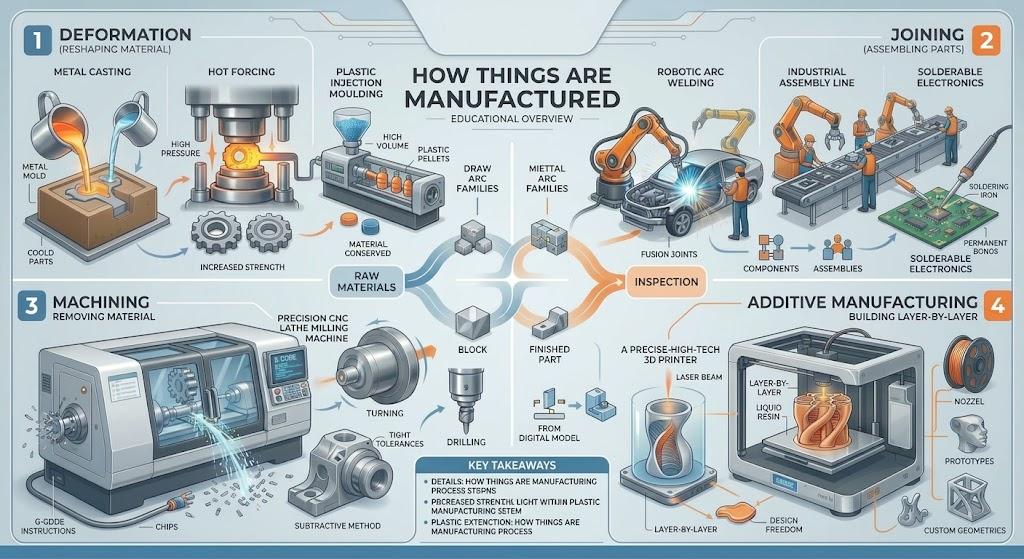
Every product around you, from the car you drive to the bottle you drink from, began as raw material. This quick course walks through how that transformation happens.
What Is Manufacturing?
Manufacturing is the process of converting raw materials into useful, valuable products, usually for economic benefit. The flow is simple: raw material goes through one or more processes, becomes a finished product, and is inspected before it ships.
With thousands of specific techniques in use, it helps to group them into four families: deformation, joining, machining and additive manufacturing. Most real products combine several of them.
Deformation (Reshaping Material)
Deformation processes change a material's shape without removing any of it, either by shaping it while liquid or by forcing it to flow while solid. Material is conserved, which makes these processes economical for high volumes.
Casting pours liquid metal into a mould cavity and lets it solidify. A pattern (a replica of the part) creates the cavity, and cores form internal holes. It suits complex shapes, from engine blocks to turbine blades. Common variants include sand casting, investment casting, die casting and centrifugal casting.
Moulding fills a hollow mould with metal or plastic. Plastic moulding alone includes injection, blow, rotational, compression and extrusion moulding, which produce items from bottle caps to water tanks.
Mechanical working shapes solid metal using force. It splits into two modes:
- Hot working happens above the recrystallisation temperature. The metal is soft and easy to shape, but surface finish and accuracy are lower.
- Cold working happens below it. It needs more force but improves strength, finish and dimensional accuracy.
Its main processes are rolling (sheets, rails, beams), forging (crankshafts, connecting rods), wire drawing and extrusion.
Best for: complex shapes, high volumes and strong parts.
Joining (Assembling Parts)
Few products are made as a single piece. Joining processes connect separate components into one assembly, either permanently or semi-permanently.
Welding fuses the base metals themselves, usually with heat, pressure or both, often adding a filler metal. A properly made weld can be nearly as strong as the parent material. Common types include arc welding (MIG, TIG, stick), resistance spot welding (used heavily on car bodies) and gas welding.
Brazing joins parts using a filler metal that melts above 450°C but below the melting point of the base metals. The base metals never melt, so distortion is lower, and dissimilar metals can be joined. It is common in pipework and tooling.
Soldering works the same way but with filler metals that melt below 450°C. Its low heat makes it ideal for electronics, where delicate components can't take high temperatures.
Beyond these thermal methods, engineers also use adhesives and mechanical fasteners such as bolts and rivets.
Best for: assemblies, structures, pipelines and electronics.
Machining (Removing Material)
Machining starts with a block, bar or rough casting and cuts away material until the desired shape remains. It is a subtractive approach, and it is the go to method when precision matters.
The main operations are:
- Turning: the workpiece rotates against a stationary cutting tool on a lathe, producing cylindrical parts like shafts and bolts.
- Drilling: a rotating bit creates round holes.
- Milling: a rotating multi-tooth cutter moves across the workpiece to produce flat surfaces, slots and complex contours.
- Shaping: a single-point tool moves back and forth to cut flat surfaces.
- Grinding: an abrasive wheel removes tiny amounts of material, giving very fine finishes and tight tolerances.
- Cutting: sawing, shearing and similar operations that separate stock to size.
Modern shops use CNC (Computer Numerical Control) machines, which follow programmed instructions to produce identical parts with remarkable accuracy. Machining often finishes parts that were first cast or forged, which is exactly why patterns are made oversized with a machining allowance.
Best for: tight tolerances, smooth surfaces and low-to-medium volumes.
Additive Manufacturing (Building Layer by Layer)
Additive manufacturing, commonly called 3D printing, reverses machining. Instead of cutting material away, a machine adds material layer by layer from a digital 3D model.
Key technologies include:
- Material extrusion: melted plastic filament is deposited through a nozzle. It is the most common and affordable method.
- Stereolithography (SLA): a laser cures liquid resin into solid layers with excellent detail.
- Vat photopolymerisation: a broader family using light to harden resin in a vat. Metal powders and other materials can also be printed using related techniques.
Its big advantages are design freedom and speed. Hollow structures, internal channels and one-off custom parts that would be impossible or costly with traditional methods become straightforward. That makes it perfect for prototyping, medical implants and low-volume specialty parts. Its limits are slower speed for mass production, size constraints and, often, rougher surface finish.
Best for: prototypes, custom parts and complex geometries.
Key Takeaways
- Deformation reshapes material efficiently, joining assembles parts, machining delivers precision, and additive offers freedom.
- No process is universally best. Choose based on shape, material, volume, precision and cost.
- Real products blend families: a gearbox housing may be cast, machined, joined and then inspected.
Understanding these four families gives you the map. Every specific technique you learn next will fit somewhere on it.
How Things are Manufactured