
From Service Exports to Industrial Intelligence:
Aligning Nepal’s Information Technology Talent Pool with the Digital Transformation of Manufacturing
July 20, 2026
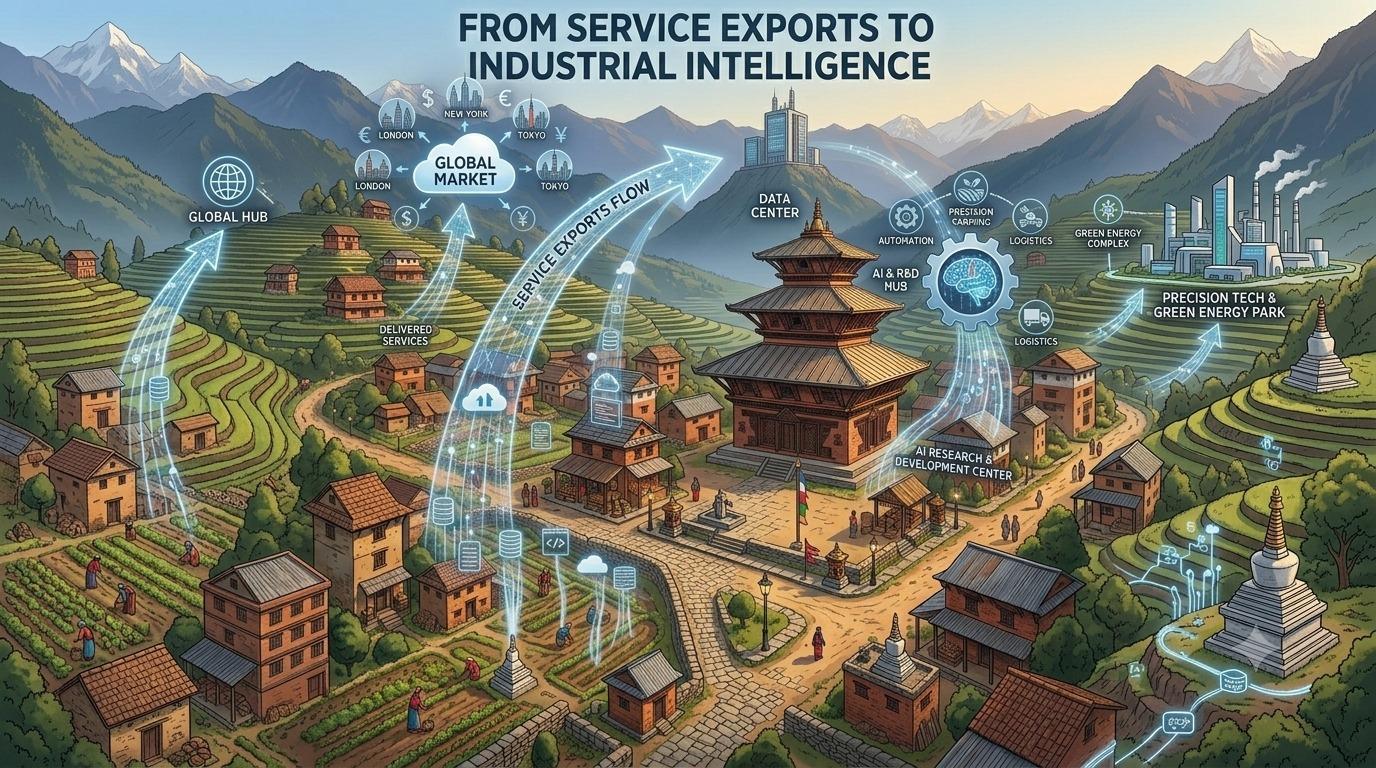
Abstract. Within roughly a decade, Nepal’s information technology (IT) service exports grew from a minor activity to an estimated one billion United States dollars per year, overtaking tourism as the country’s leading service export. Prevailing accounts attribute this expansion primarily to low labor costs. This paper argues that such an explanation is incomplete and potentially misleading for policy: the more durable comparative advantage lies in the depth and demonstrated quality of the country’s engineering talent. Drawing on triangulated secondary data industry-association estimates, central-bank balance-of- payments statistics, World Bank and World Trade Organization measures, market-research reports, and firm-level disclosures we characterize the scale, composition and capability of the Nepalese IT workforce, and interpret the large discrepancy between official and industry export figures as an indirect signal of distributed, client-validated quality. We then examine the global digital transformation of manufacturing, a market on the order of several hundred billion dollars in which value is migrating from hardware toward software and artificial intelligence (AI). Mapping demonstrated Nepali competencies computer vision and data annotation, large-scale data analytics, enterprise AI, and high-throughput transactional systems onto the requirements of smart manufacturing, we contend that the workforce is well positioned to enter this domain. We discuss risk factors (talent emigration, measurement opacity, policy and tax uncertainty, financial-system informality, and geographic concentration), state the limitations of the available evidence, and outline a research and policy agenda. Keywords: IT service exports, Nepal, Digital transformation, Smart manufacturing, Industry 4.0 · Offshore software engineering, Talent economics, Technology policy.
1 Introduction
The international image of Nepal is dominated by tourism, agriculture, and the export of manual labor. This image is increasingly out of date. Over the past decade the country has developed a substantial software and IT-enabled services export sector; by 2025, industry bodies estimated its annual value at approximately one billion United States dollars (USD), having more than doubled in three years, with the sector overtaking tourism as the leading source of service-export earnings [1, 2, 4].
The dominant explanation for this growth emphasizes cost: Nepali engineers are inexpensive relative to comparable talent in India or in high-income economies, and work is said to have followed the price differential. We do not dispute that cost lowers the barrier to a first engagement. We argue, however, that cost is an insufficient explanation for the persistence and complexity of the work now performed in Nepal, and that treating cost as the principal selling proposition is a strategic error. A price-based position is structurally fragile: the lowest-cost provider is, by definition, always replaceable by a cheaper one, and generative AI is rapidly commoditizing routine software tasks. A capability-based position is more defensible.
This paper makes three contributions. First, it consolidates fragmented public evidence on the scale and composition of Nepal’s IT workforce and interprets the well-documented gap between official and industry export figures as an indirect indicator of distributed, client-validated quality (Section 4). Second, it characterizes the global digital transformation of manufacturing as a large, software-intensive market whose value is migrating into precisely the competencies the Nepali sector has demonstrated (Section 5). Third, it advances and qualifies a capability–demand alignment argument, mapping observed competencies onto manufacturing-DX(Digital Transformation) applications, and identifies the conditions and risks that bear on whether the opportunity can be realized (Sections 6 and 7). The paper is positional and analytical rather than empirical; Section 3 states the data and method, and Section 7.3 the resulting limitations.
2 Background and related work
2.1 Nepal’s IT services sector
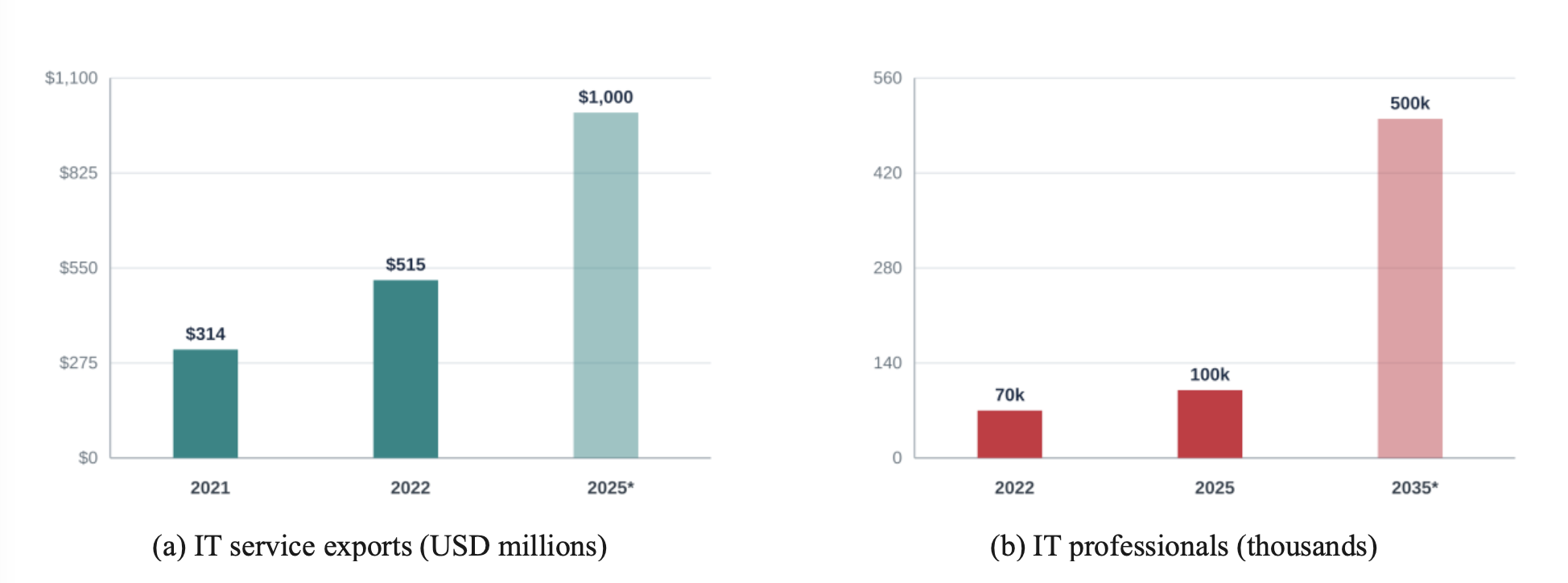
The most frequently cited baseline is a 2022 study by the Institute for Integrated Development Studies (IIDS), which valued Nepal’s IT service exports at about USD 515 million, an increase of roughly 64% over the prior year, and identified IT as having overtaken tourism among service exports [4, 5]. Subsequent industry estimates from the Nepal Association for Software and IT Services (NAS-IT) place the 2025 figure near USD 1 billion [1, 2]. Reported workforce estimates rose from more than 70,000 professionals in 2022 to approximately 100,000 in 2025, with employment concentrated (around 90%) in the Kathmandu valley [1]. The Government of Nepal has designated a ten-year “IT Decade” and, in the fiscal-year 2025/26 budget, granted the sector “special industry” status with substantial tax relief on export income [6].
2.2 The digital transformation of manufacturing
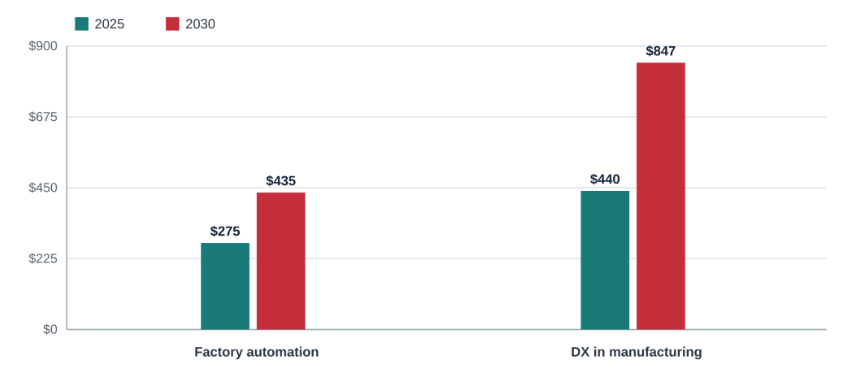
The instrumentation, simulation and AI-assisted operation of production systems variously termed Industry 4.0, smart manufacturing, or the digital transformation (DX) of manufacturing constitutes one of the larger industrial software markets. Market-research estimates vary by scope, but place factory automation in the several-hundred-billion-USD range and the broader manufacturing-DX layer on a trajectory toward roughly USD 800 billion or more by 2030 [12, 13]. A recurring observation across these sources is that the fastest-growing and highest-margin components are software and services rather than hardware [14]. The World Economic Forum has estimated that Industry 4.0 could add trillions of USD in manufacturing value [15]; such figures should be read as indicative rather than precise.
2.3 Location economics: cost versus capability
The economic-geography literature on offshoring distinguishes between cost-driven and capability- driven location decisions. Cost arbitrage tends to attract commodifiable, well-specified tasks that are easily relocated; capability-driven sourcing attracts complex, trust-dependent work that is comparatively “sticky.” The distinction matters for policy because the two trajectories imply different upgrading paths and different exposure to commoditization. The present paper applies this lens to Nepal, asking which trajectory the available evidence supports.
3 Data and method
This is an analytical, position-oriented study based on secondary sources rather than primary data collection. Five source types are used: (i) industry-association estimates (NAS-IT) reported through national media; (ii) official balance-of-payments statistics from Nepal Rastra Bank (NRB); (iii) international statistical measures from the World Bank and the World Trade Organization (WTO); (iv) commercial market-research reports for the manufacturing-DX and factory-automation markets; and (v) firm-level information from company and sector reporting. Because these sources differ in definition, coverage and year, we triangulate rather than aggregate: where estimates diverge, we report the range and treat the divergence itself as analytically informative (Section 4.2). All monetary figures are nominal USD unless stated otherwise. The method’s limitations reliance on estimates, potential selection bias in firm exemplars, and the absence of primary capability measurement are discussed in Section 7.3.
4 The Nepali IT talent pool
4.1 Growth and scale
Figure 1 summarizes the two headline trends. Panel (a) shows the estimated trajectory of IT service exports, from roughly USD 314 million in 2021 (derived from the IIDS 2022 figure and its reported year-on-year growth) to about USD 515 million in 2022 and an estimated USD 1 billion in 2025. Panel (b) shows reported employment growth and the sector’s stated decade target of approximately 500,000 jobs, predicated on sustained annual growth near 18% [1, 2]. We emphasize that the 2025 values are industry estimates rather than audited national accounts.
4.2 Measurement opacity as a quality signal
A notable feature of the sector is that official statistics capture only a fraction of estimated activity. NRB balance-of-payments data record computer and information services of under USD 90 million in one recent half-year (on the order of USD 175 million annualized), whereas industry estimates for the same period approach USD 1 billion, a discrepancy exceeding an order of magnitude [3]. International measures fall between these poles: the World Bank’s narrower ICT-services figure was about USD 118 million (2022) and the WTO’s broader “digitally
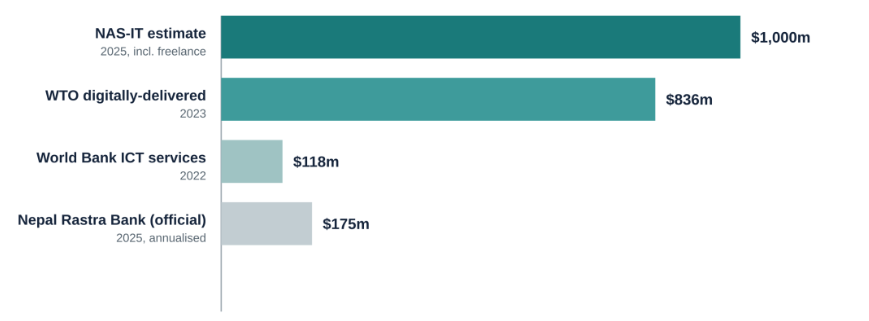
The conventional interpretation of this gap is a measurement and tax-administration problem, since much revenue reaches freelancers and small studios through payment platforms and overseas intermediaries that bypass the domestic banking system [3]. We add a complementary interpretation. A large share of the uncaptured revenue corresponds to engineers selected individually by overseas clients in competitive markets. Unlike an aggregate that can be inflated, or a contract that may reflect non- market factors, tens of thousands of independent client decisions constitute a distributed, repeated market test of quality. The opacity that frustrates the statistician is, read differently, evidence that the demand is capability-driven.
4.3 Firm-level evidence of high-complexity capability
Firm-level evidence is consistent with capability-driven demand. We summaries three representative providers; these are illustrative, not a random sample (see Section 7.3).
– Enterprise AI. Fusemachines, founded in 2013 by a Nepali computer scientist and reported to be the first Nepali-founded firm to list on the NASDAQ exchange (late 2024), operates a Kathmandu hub of more than 200 engineers, including doctoral-level staff, building enterprise AI for clients in retail, healthcare and finance; its AI Fellowship has trained machine-learning talent since 2017 [8, 10].
– Human-in-the-loop AI and computer vision. CloudFactory’s Nepal operation performs data- pipeline construction, model evaluation and annotation for computer vision in autonomous-vehicle and medical-imaging applications, increasingly including large-language-model fine-tuning, using a production toolchain (e.g., Python, Kubernetes) at a scale comparable to major regional hubs [9].
– Large-scale data analytics. Cotiviti’s Kathmandu center (established 2004) employs on the order of 600 engineers and data scientists building analytics that detect fraud, waste and abuse in the United States healthcare system, used by more than 180 payers including federal agencies [8].
Additional providers include F1Soft Group, whose eSewa and Fonepay platform reportedly processes payments on the order of USD 25 billion annually, alongside analytics and cybersecurity firms [8]. Reported compensation for senior AI roles, and direct freelance billing of several thousand USD per month, are further indirect indicators that the work is not confined to low-complexity tasks [9].
4.4 The education pipeline
The workforce is replenished by a sizeable tertiary pipeline. Tribhuvan University’s Bachelor of Science in Computer Science and Information Technology programme alone enrolls over 3,000 students per year across some 60 affiliated colleges, complemented by computer-engineering programmes at the Institute of Engineering and other universities [11]. The pipeline is therefore broad; its principal weaknesses, discussed below, are curricular currency and the retention of graduates.
5 The manufacturing digital-transformation opportunity
The destination market we propose is the digital transformation of manufacturing. Production is shifting from electromechanical systems toward cyber-physical systems in which sensing, simulation, analytics and AI determine machine behavior. As noted in Section 2.2, the software and services layer is both the larger and the faster-growing portion of this market, and the highest-margin one (Fig. 3). Two implications follow for a landlocked, hardware-light economy. First, the value is concentrating in exactly the software and AI competencies the Nepali sector has demonstrated. Second, software and engineering services are delivered over telecommunications infrastructure rather than physical logistics, so the geographic constraints that disadvantage Nepali goods exports do not bind on this category.
6 Capability demand alignment
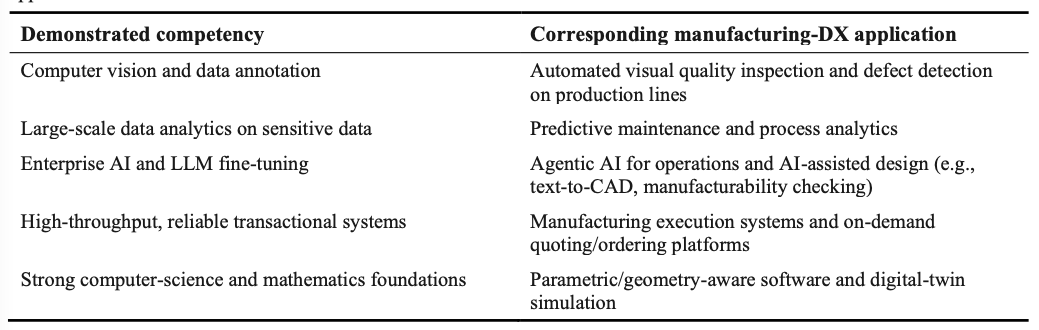
The central claim of the paper is that the competencies demonstrated by Nepali firms (Section 4.3) correspond closely to the requirements of manufacturing DX. Table 1 states the correspondence. The mapping is intended as an analytical hypothesis rather than a demonstrated transfer; its validation is proposed as future work (Section 7.3).
Table 1. Hypothesized alignment between demonstrated Nepali IT competencies and manufacturing digital-transformation applications.
7 Discussion
7.1 Strategic implications
The analysis implies a reorientation of how the sector is positioned, from “low-cost delivery” to “high- capability engineering,” and a targeted move up the value chain into manufacturing DX rather than diffuse expansion of generic outsourcing. For firms, this favors investment in domain specialization and in training pipelines of the kind exemplified by the AI-fellowship model. For policy, it favors measures that retain talent and that reduce the financial and regulatory frictions identified below.
7.2 Risk factors
Several factors could prevent realization of the opportunity. Talent emigration: a large fraction of computing graduates is reported to leave the country, so the binding constraint is retention rather than supply. Curricular lag: industry sources report that curricula trail a rapidly changing field, shifting re- training costs onto employers. Policy and trust shocks: tax disputes involving foreign-invested firms have reportedly discouraged investment and illustrate the chilling effect of regulatory uncertainty [6]. Financial-system informality: reliance on payment platforms and informal channels constrains capital formation, contracting and scale [3]. Geographic concentration: the heavy concentration of activity in Kathmandu raises infrastructure and resilience concerns [1]. Countervailing factors include a deepening talent pipeline, English-language proficiency and time-zone complementarity with European, Japanese and Australian clients, recent supportive policy, and a growing hydropower surplus advantageous for compute-intensive AI workloads.
7.3 Threats to validity and limitations
The study has clear limitations. First, the core figures are industry estimates and secondary statistics that diverge substantially (Section 4.2); they are not audited and should be treated as indicative. Second, the firm-level evidence is purposively selected to illustrate high-complexity capability and is therefore subject to selection bias; it does not establish the modal capability of the sector. Third, the capability– demand alignment of Table 1 is a hypothesis: this paper does not measure actual skill transfer into manufacturing-DX settings. Fourth, market-research figures for the destination market are vendor estimates that vary by methodology and scope. These limitations motivate the agenda below.
8 Conclusion and future work
Nepal’s emergence as a billion-dollar IT-service exporter is better explained by the quality and depth of its engineering talent than by labor cost alone, and the distributed, client-validated nature of much of this demand is evidence of a capability-driven rather than cost-driven trajectory. The competencies the sector has demonstrated computer vision, large-scale analytics, enterprise AI and high-throughput systems align closely with the requirements of the digital transformation of manufacturing, a large and software-intensive market whose value is migrating toward exactly these skills and whose delivery is not constrained by Nepal’s geography. Realizing the opportunity depends on retaining talent, modernizing curricula, and reducing financial and regulatory frictions.
Future work should (i) conduct primary survey research to measure the sector’s modal competencies, firm sizes and revenue composition; (ii) develop a longitudinal, methodologically consistent measure of digital-service exports to resolve the measurement gap; and (iii) empirically test the capability– demand alignment through pilot engagements in manufacturing-DX tasks, measuring quality, lead time and client retention against incumbent providers.
Declarations
All data are drawn from publicly available secondary sources cited in the references; no new datasets were generated.
References
- Kathmandu Post: Nepal’s IT exports near $1 billion. Can the momentum be sustained? (25 February 2026)
- Fiscal Nepal: Nepal’s IT service exports reach estimated Rs145 billion annually (NAS-IT / G. R. Pandey). (12 February 2026)
- Katmandu Journal: How big is Nepal’s IT sector, really? (NRB, World Bank and WTO figures). (26 February 2026)
- Institute for Integrated Development Studies (IIDS): Study of Nepal’s IT service exports, 2022. Reported via Tech Peak Nepal 2024 (CNI/NAS-IT/AmCham).
- South Asia Watch on Trade, Economics and Environment (SAWTEE): Unlocking Nepal’s IT services export. Trade, Climate Change and Development Monitor 21(4) (April 2024)
- Niriv: Is Nepal losing ground in the IT sector to India? GDP share, FY2025/26 budget measures, and the Cotiviti tax case. (17 February 2026)
- Statista Market Forecast: IT Services — Nepal. (2024)
- Noble Stack: List of technology companies in Nepal (Fusemachines, Cotiviti, F1Soft). (13 December 2025)
- Nucamp: Top companies hiring AI engineers in Nepal (2026); Getting a job in tech in Nepal (CloudFactory; compensation). (2025–2026)
- DataMites: Top IT companies in Nepal (Fusemachines headcount). (2024)
- Edusanjal; CollegesNepal: BSc CSIT and Institute of Engineering programme data. (2024–2026)
- MarketsandMarkets: Industrial Control & Factory Automation Market — Global Forecast to 2030. (2026)
- Mordor Intelligence: Digital Transformation in Manufacturing Market. (2025–2026)
- Grand View Research: Factory Automation Market Report. (2025)
- World Economic Forum: Estimates of Industry 4.0 value creation in manufacturing. (reported figure; indicative)
From Service Exports to Industrial Intelligence(PDF)
Download from-service-exports-to-industrial-intelligence-pdf.pdf