
Nepal As The Next Big Hub for Data and IT
AI Expansion, Young Talent, and the Strategic Rise of a New Digital Economy
July 6, 2026

Abstract. Nepal is increasingly described as an emerging destination for information-technology (IT) and data services, yet the evidence base for this claim is fragmented and its strategic implications are rarely examined systematically. This paper synthesizes publicly available data on Nepal's IT exports, demographics, energy endowment, and digital infrastructure, and positions the country against established and emerging offshoring hubs. We find that headline export figures differ by nearly an order of magnitude depending on measurement methodology; that Nepal's structural advantages a young, low cost, English capable workforce and abundant renewable hydropower are genuine but offset by a thin senior talent layer, infrastructure gaps, an immature data protection regime, and a weak international brand. We argue that Nepal cannot compete on scale and should instead specialize in higher value, judgment intensive segments of the artificial intelligence (AI) data economy. A SWOT analysis, a directional risk assessment, a threephase roadmap to 2035, and scenario projections are presented. The central conclusion is that Nepal's potential is real but conditional on disciplined execution across skills, infrastructure, regulation, and branding.
Keywords: Digital economy, IT services offshoring, Artificial intelligence, Data annotation, Demographic dividend, Hydropower, Nepal, Emerging markets
1 Introduction
The global market for IT-enabled and AI-related data services has expanded rapidly, and a new generation of lower cost economies is competing to capture a share of work that was once concentrated in a handful of established hubs. Within South Asia, Nepal is frequently cited often in policy rhetoric and investment commentary as a candidate “next” destination for software, business-process, and data-annotation services. The Government of Nepal has reinforced this narrative, declaring a “Decade of Information Technology” and opening the sector to full foreign direct investment [3].
Despite this attention, rigorous analysis of Nepal's actual position is scarce. Reported export values vary widely between sources, the underlying assets are unevenly documented, and discussion tends to oscillate between uncritical optimism and dismissal. This paper addresses that gap. Specifically, it asks: (i) what is the measurable current state of Nepal's IT and data-services economy; (ii) which structural assets and constraints shape its trajectory; (iii) how does Nepal compare with relevant peer economies; and (iv) what strategic posture is most defensible given these conditions.
The contribution is threefold. First, we consolidate fragmented public data into a single, source-attributed picture and make explicit the measurement discrepancies that distort the headline narrative. Second, we provide a comparative and strategic assessment SWOT, risk, roadmap, and scenarios grounded in that data. Third, we advance a specific thesis: that Nepal's viable path is specialization in higher-value AI-data work rather than scalebased competition. The remainder of the paper is organized as follows. Section 2 reviews relevant background. Section 3 describes data and methods. Sections 4–5 establish the current state and foundational assets. Sections 6– 7 address comparative positioning and the AI-economy opportunity. Sections 8–9 present the SWOT, risk, roadmap, and scenario analyses. Sections 10–11 discuss implications and conclude.
2 Background and Related Work
The offshoring of IT and business-process work is a mature phenomenon dominated by India and the Philippines, whose industries are measured in the tens to hundreds of billions of U.S. dollars and employ millions of workers [7,8]. A second wave encompassing Vietnam, Bangladesh, Sri Lanka, and Pakistan has grown around cost arbitrage and improving digital infrastructure, though comparable national export figures for several of these economies are not consistently published.
A distinct and faster-growing segment has emerged around AI: the collection, annotation, and quality assurance of training data, together with model evaluation and human-in-the-loop review. Market analysts estimate the global data-collection-and-labeling market at roughly US$3.8 billion in 2024, growing at approximately 28% annually toward 2030 [5]. This segment is significant for lower-income economies because its entry-level tasks require limited capital and can be performed remotely but it is also the segment most exposed to automation and wage competition. Nepal already hosts a notable proof point: CloudFactory, an internationally active data-operations firm founded in Kathmandu, demonstrates that globally competitive delivery from Nepal is feasible. The present work situates Nepal within this dual landscape of mature offshoring and the emerging AI-data economy.
3 Data and Methodology
This study is a synthesis of secondary data drawn from official statistics, multilateral databases, industry associations, and market-research publications. Principal sources include national census and demographic data [4,12,13], central-bank and telecommunications statistics [1,10], energy-sector reporting [2,11], industry and association estimates [6,7,8,9], multilateral trade and balance-of-payments datasets [14,15], and AI-market research [5].
Two methodological cautions apply throughout. First, Nepal's IT export figures are measured inconsistently: balance-of-payments series and industry estimates diverge substantially because a portion of IT earnings is recorded as personal remittances rather than service exports. We therefore present multiple estimates side by side rather than adopting a single figure. Second, for several comparator economies, precise and current national export totals are not reliably available; where this is the case, comparative statements are treated as directional and qualitative, and are explicitly marked. Forward-looking elements the roadmap and scenarios are analytical constructs based on stated assumptions, not forecasts. These limitations are discussed further in Section 10.
4 The Current State of Nepal’s Digital Economy
Estimates of the size of Nepal's IT and data-services exports vary by methodology, as shown in Fig. 1. Balanceof-payments figures place ICT service exports at roughly US$118 million in 2022, rising to around US$318 million by 2024 [14]. Industry estimates are considerably higher on the order of US$515 million for 2022 [6] while broader measures of digitally delivered services reach approximately US$836 million for 2023 [15], and association estimates approach US$1 billion for 2026 [9]. The divergence is not merely statistical noise: it reflects the misclassification of IT earnings as remittances and differing scope definitions. Any claim about Nepal's export performance must therefore specify which measure it uses.
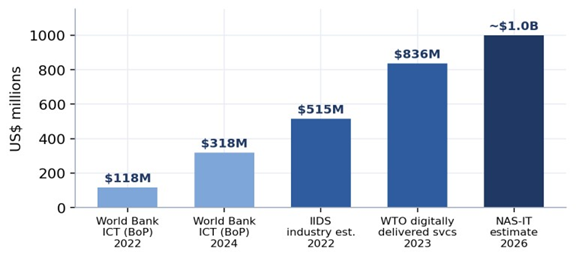
Fig. 1. Estimates of Nepal’s IT/data-service exports differ markedly by measurement method. Sources: World Bank [14]; IIDS [6]; WTO [15]; NAS-IT [9].
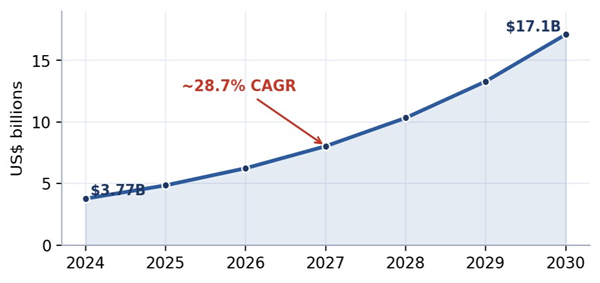
The strategic relevance of these figures is amplified by the growth of the addressable market. As Fig. 2 illustrates, the global data-collection-and-labeling market is projected to expand from roughly US$3.8 billion in 2024 to approximately US$17 billion by 2030, an annual growth rate near 28% [5]. Even a modest share of this expanding market would be material relative to Nepal's current export base, which underscores why the sector attracts policy attention.
5 Foundational Assets and Constraints
5.1 Talent and Demographics
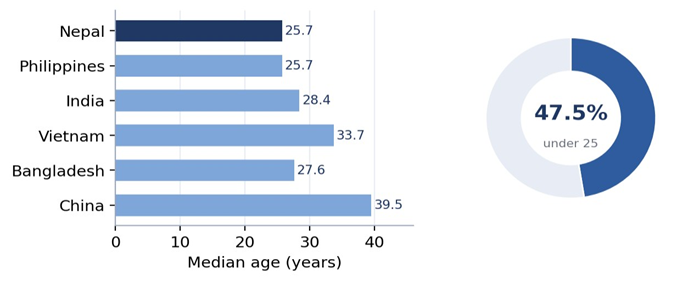
Nepal's principal asset is its population structure. The median age is approximately 25.7 years and close to 47.5% of the population is under 25 [12,13], affording a long demographic runway relative to ageing peer economies (Fig. 3). The labor pool is augmented by a substantial annual output of IT graduates and by broad exposure to English. The constraints are depth and retention rather than quantity: the senior architect and technical-leadership layer is thin, digital literacy is estimated at around 31% against general literacy of roughly 76% [4], and sustained outmigration draws skilled workers abroad.
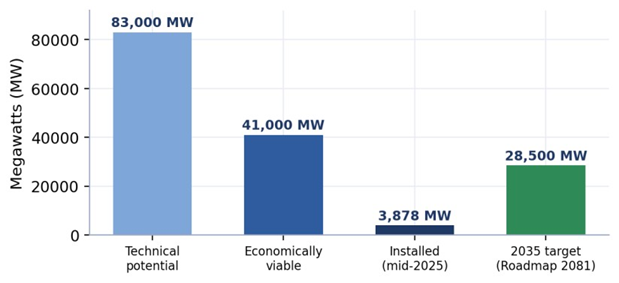
Energy is Nepal's structural differentiator. More than 90% of generated electricity is renewable, drawn predominantly from hydropower, and the country has become a net exporter to neighboring markets. As Fig. 4 shows, installed capacity (about 3,878 MW in mid-2025) remains a small fraction of the economically viable potential, and national policy targets 28,500 MW by 2035 [2,11]. This endowment underpins a credible case for green, low-carbon data-center capacity although seasonal variability, grid stability, and the country's landlocked geography make this a medium-term opportunity rather than an immediate guarantee.
5.2 Energy Endowment
5.3 Connectivity and Digital Infrastructure
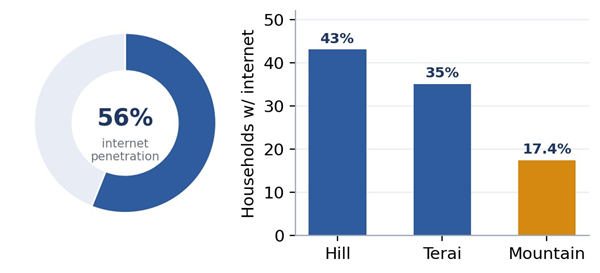
Connectivity is solid but uneven. Internet penetration stands at roughly 56%, covering about 16.6 million users [1], with mobile broadband providing the majority of access [10]. However, household connectivity is markedly higher in the hills than in the mountains (Fig. 5), reflecting a persistent geographic digital divide [4], and no commercial fifth-generation (5G) network is yet in operation. Infrastructure is therefore adequate to support remote service delivery from urban centers today, but uneven enough to constrain a fully distributed national model in the near term.
6 Comparative Positioning
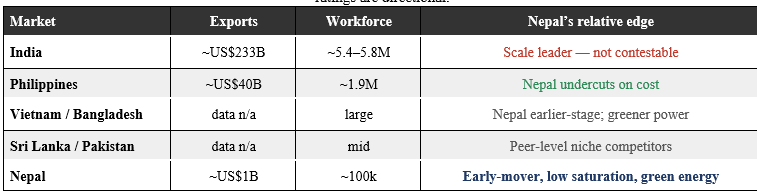
Benchmarked against established hubs, Nepal's scale disadvantage is decisive. As Fig. 6 shows on a logarithmic axis, India's IT/ITES exports (on the order of US$233 billion) and the Philippines' (around US$40 billion) exceed Nepal's by roughly two orders of magnitude [7,8]. Competing on volume is therefore not a realistic strategy. Table 1 summarizes the comparative picture; precise export values are reported only where verifiable, and qualitative ratings are used elsewhere.
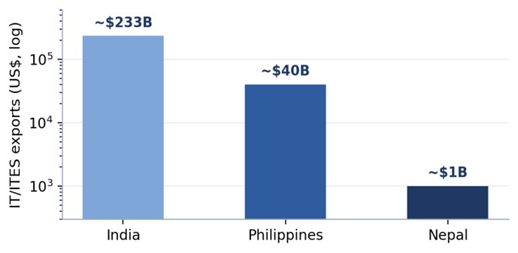
Table 1. Comparative positioning of Nepal against selected economies. “Data n/a” denotes figures not reliably available; ratings are directional.
If scale is unavailable, the strategic question becomes where within the AI-data value chain Nepal can build a defensible position. Fig. 7 maps candidate service segments along two axes: the value of the work and its resilience to automation, with bubble size indicating ease of entry. Entry-level data annotation is the easiest to enter but the most exposed to both automation and low-cost competition. The more durable opportunities lie in the upper-right region human-in-the-loop review, model evaluation and red-teaming, domain-specific data work (for example, computer-aided-design and engineering data, or regulated healthcare, finance, and legal data), and AI governance support where domain expertise and trust resist commoditization [5].
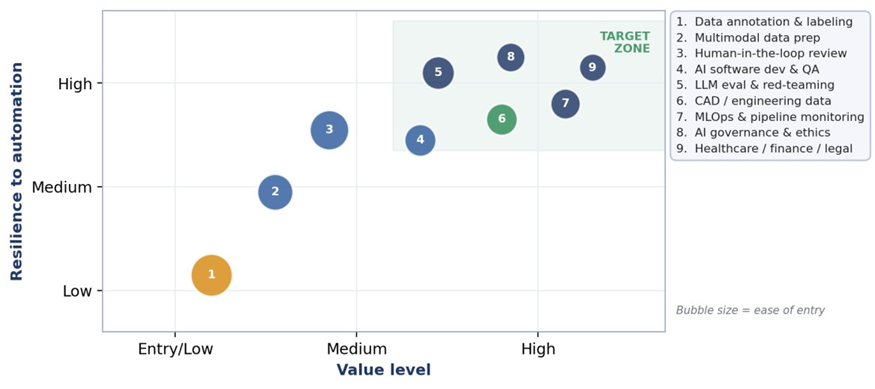
This framing implies a deliberate trajectory: use accessible, lower-value tasks as an on-ramp to build capability and client relationships, while investing early in the skills, certifications, and domain knowledge required to migrate into the higher-value, automation-resilient segments before the entry-level base erodes.
8 SWOT and Risk Assessment
The preceding analysis is consolidated in the SWOT summary of Fig. 8. A recurring pattern is that each strength is matched by a corresponding vulnerability youthful, low-cost labor against a thin senior layer and out-migration; abundant green power against grid and transmission limitations; an early-mover position against a weak brand and immature regulation.
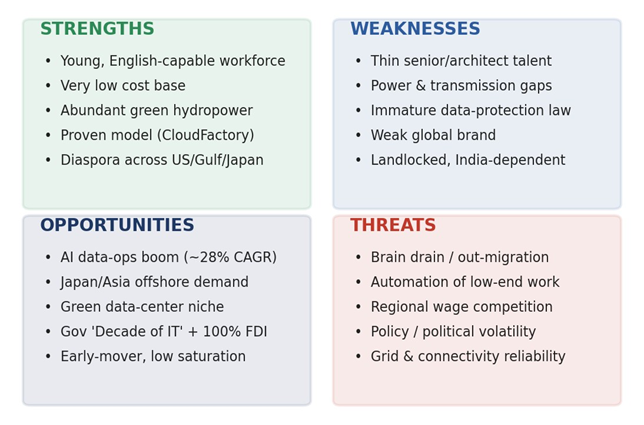
Table 2 translates the principal threats into a directional risk assessment with candidate mitigations. The two highest-priority risks skilled out-migration and the automation of low-end work are mutually reinforcing: both erode the entry-level base that an early-stage industry depends upon, which strengthens the argument for an early move up the value chain.
Table 2. Principal risks (rated directionally) and candidate mitigations.
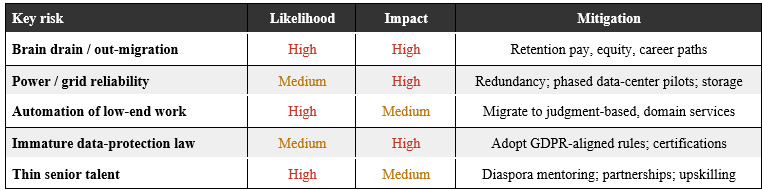
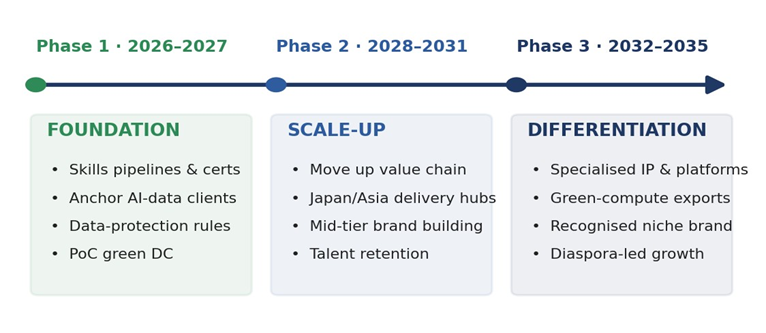
Fig. 9 sets out a three-phase roadmap to 2035. The foundation phase (2026–2027) prioritizes skills pipelines, anchor clients, a data-protection framework, and a green data-center proof of concept. The scale-up phase (2028– 2031) emphasizes moving up the value chain, establishing Asia-facing delivery hubs, building a mid-tier brand, and improving talent retention. The differentiation phase (2032–2035) targets specialized intellectual property, green-compute exports, a recognized niche brand, and diaspora-led growth.
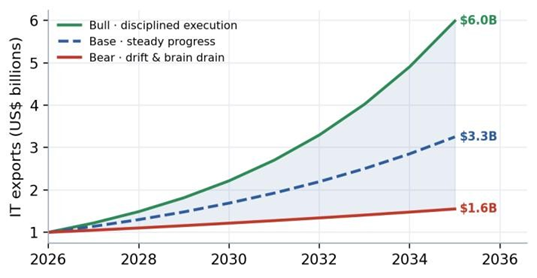
To make the stakes explicit, Fig. 10 presents three illustrative export trajectories to 2035 under differing execution assumptions. These are analytical scenarios rather than forecasts: the bull case assumes disciplined execution across skills, infrastructure, and regulation; the base case assumes steady but unremarkable progress; and the bear case assumes policy drift and unmitigated brain drain. The width of the resulting fan emphasizes that the outcome depends far more on execution than on Nepal's underlying endowment, which is largely fixed in the medium term.
10 Discussion
The analysis supports a qualified conclusion: Nepal's potential as a data and IT hub is real but conditional. The country possesses a coherent set of advantages demographic, economic, and energy-related that few peer economies combine, and it operates in a market segment whose growth is unusually rapid. Yet none of these advantages is self-executing. The demographic dividend is contingent on retention and skilling; the energy advantage is contingent on grid investment and data-center development; and the early-mover position is contingent on building a brand and a regulatory regime credible enough to win regulated, higher-value work.
Three implications follow. First, policy and investment should be selective rather than broad: concentrating on judgment-intensive, domain-specialized AI-data services offers a more defensible position than competing for commodity volume. Second, the binding constraints are institutional talent depth, data-protection law, and branding more than they are physical, which means they are addressable through deliberate policy and firm-level action. Third, because the entry-level base is simultaneously the easiest on-ramp and the most automatable, timing matters: the migration up the value chain should begin early.
Several threats to validity should be noted. The export estimates rest on inconsistent measurement, and we have deliberately presented a range rather than a point estimate. Comparative claims for second-wave economies are constrained by data availability and are treated as directional. The roadmap and scenarios are analytical instruments whose parameters are assumptions, not empirical projections, and should be read as illustrative of sensitivity to execution rather than as predictions. Future work should prioritize primary data collection on Nepal's IT workforce and firm-level export performance, and a more formal treatment of the automation exposure of specific task categories.
11 Conclusion
This paper has consolidated fragmented public evidence on Nepal's emerging data and IT economy, positioned the country against relevant peers, and proposed a strategic posture grounded in that evidence. The central finding is that Nepal should not pursue scale-based competition, for which it is structurally disadvantaged, but should instead specialise in higher-value, automation-resilient segments of the AI-data economy, leveraging its young workforce, low cost base, and abundant green energy. Whether this potential is realised will depend less on Nepal's endowment—which is favourable—than on disciplined execution across skills development, infrastructure, regulation, and international branding over the coming decade.
References
1. DataReportal: Digital 2026: Nepal. Kepios / We Are Social (2026)
2. Government of Nepal, Ministry of Energy, Water Resources and Irrigation: Energy Development Roadmap and Action Plan 2081. Kathmandu (2024)
3. Government of Nepal, Ministry of Finance: Budget Speech FY2024/25: Decade of Information Technology. Kathmandu (2024)
4. Government of Nepal, National Statistics Office: National Population and Housing Census 2021. Kathmandu (2021)
5. Grand View Research: Data Collection and Labeling Market Size, Share & Trends Report, 2024–2030. Grand View Research (2024)
6. Institute for Integrated Development Studies (IIDS): Nepal’s IT Industry: Export Potential and Contribution. IIDS, Kathmandu (2022)
7. IT and Business Process Association of the Philippines (IBPAP): Philippine IT-BPM Industry Performance and Roadmap Update. IBPAP (2025)
8. NASSCOM: Technology Sector in India: Strategic Review. NASSCOM (2025)
9. Nepal Association for Software and IT Companies (NAS-IT): State of Nepal’s IT Sector. NAS-IT (2026)
10. Nepal Telecommunications Authority (NTA): MIS Report on Telecommunications and Internet. NTA (2025)
11. South Asia Subregional Economic Cooperation (SASEC): Installed Electricity Capacity for Nepal Reaches 3,878 MW. SASEC News (2025)
12. United Nations, Department of Economic and Social Affairs, Population Division: World Population Prospects: The 2024 Revision. United Nations (2024)
13. United Nations Population Fund (UNFPA): Nepal: Young People and the Demographic Dividend. UNFPA Nepal (2024)
14. World Bank: ICT Service Exports (BoP, current US$) — Nepal. World Development Indicators (2024)
15. World Trade Organization (WTO): Digitally Delivered Services Trade Dataset — Nepal. WTO (2024)
Nepal as the Next Big Hub for Data and IT
Download nepal-as-the-next-big-hub-for-data-and-it.pdf